
You’ve booked the trip. You’re excited. And then the small voice in the back of your head starts asking But what about the time change?
I’ve been traveling internationally with kids since my boys were infants. Hong Kong with a one-year-old, Maui at five months, and European travel before they could walk meant jet lag was my constant companion whether I wanted it or not.

TL; DR
Don’t have time to read the full article?
Here are my top travel favs:
- Hotels & Rentals
- Tours
- Cheap Flight Tracker
- Rental Car
- Flytographer ($20 off your first photo session)
Jet lag with babies and toddlers is real, but it is not the trip-ruiner people make it out to be.
Once you understand what’s actually happening in their little bodies and have a few concrete strategies in place, you can stop dreading the time change and start dealing with it, just like everything else that happens when you have a baby.

Why Babies and Toddlers Get Hit So Hard
Jet lag happens when your internal body clock (your circadian rhythm) falls out of sync with local time. For adults, that means dragging through the afternoon or staring at the ceiling at 3 a.m.
For babies and toddlers, it tends to hit harder because their entire world is built around routine.
Sleep, wake, eat, play: it all operates on a predictable internal schedule. Cross several time zones, and that schedule gets scrambled.
Babies between 4 and 12 months can typically handle a circadian shift of about 15 to 30 minutes per day, while toddlers over 12 months can usually manage 30 to 60 minutes per day.
That’s why full adjustment after a big international trip takes several days. You’re not going to fix it on arrival day, and expecting to will only frustrate you and ruin your trip.
Most babies and toddlers fully adjust within 3 to 5 days, depending on how many time zones you’ve crossed. Plan accordingly and give yourself some grace on Day 1.

Before You Leave: Do a Little Prep Work
You don’t need to overhaul your baby’s entire schedule before a trip, but a small amount of pre-departure prep helps.
Starting 3 to 5 days before your flight, gradually shift their schedule by 15 to 30 minutes per day toward the new time zone. If you’re flying east and need an earlier bedtime, start nudging it a little earlier each night.
It won’t get them all the way there, but it takes some of the shock off when you land.
Also, prioritize good sleep the night before your flight. Overtired kids struggle more with transitions. This is not the night to push bedtime, but since you can’t force your kids to have a good night’s sleep (trust me, I’ve tried), don’t panic if you get on the plane with a tired baby.
You WILL Survive.
On the Plane: Let Them Sleep
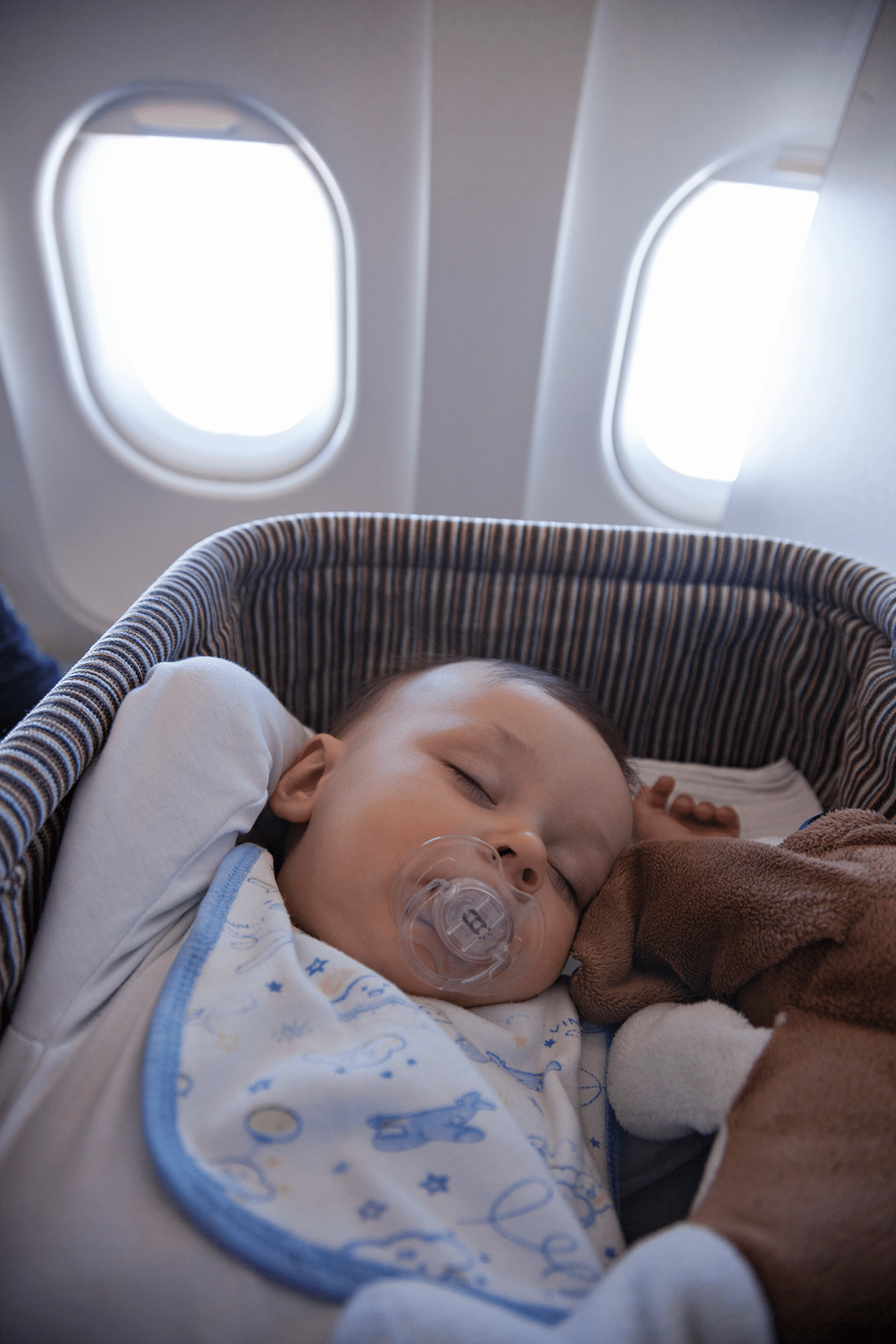
On a long flight, let your baby sleep whenever they want to. Bring a lightweight dark blanket and drape it to block out cabin light. Just don’t lay a blanket directly on top of your baby.
The airline bassinet, if you’ve reserved one and your baby qualifies by weight, is a big help.
If sleep isn’t happening and you’ve been trying to force it for a while, stop. Forcing sleep often makes it harder for small children to fall asleep. Change it up by walking the aisle, changing the diaper, offering a snack, or reading a book.
Let everyone reset before trying again.
For long-haul flights, I always packed a dedicated sleep bag with the same items we used at home for bedtime, like a familiar blanket, a lovey, whatever comfort objects were part of our routine.
Those sleep cues matter. Even in a cramped plane seat, they signal to a baby’s brain that sleep is coming.
When You Arrive: Switch to Local Time Immediately
Skip the debate about whether to keep your baby on your home time. It does not work.
Switch to local time the moment you land and don’t look back. The longer you try to straddle two time zones, the harder the adjustment becomes.
Get outside as soon as you can after arriving.
Natural light is the most powerful tool you have for resetting your baby’s body clock and your own. If it’s daytime, get them moving: let them crawl on the hotel room floor, let a toddler run in a park, just get that energy out.
If you arrive at night, a brief evening stroll can still help their body register that it’s nighttime.
Consider any sleep between 7 a.m. and 7 p.m. a nap, and try not to let them sleep significantly longer than they would at home during those hours. You want to preserve enough sleep pressure to get a real night’s sleep.
Meals follow the same logic. Shift to eating at local meal times as quickly as possible. You may need extra snacks during the first couple of days, but getting mealtimes aligned with the new time zone helps reset their internal clock alongside sleep.
Keep Your Sleep Routine Exactly the Same
This is the single most effective thing you can do. Whatever your bedtime routine is at home (bath, books, feeding, white noise, whatever sequence you’ve established), replicate it as closely as possible every single night of the trip.
The bedtime routine cues your baby’s brain for sleep. Even in an unfamiliar environment, those familiar activities help their body prepare.
Dim the lights 15 to 30 minutes before you want them asleep. Skip screens. Go through the motions.
It doesn’t matter if you’re in a hotel room in Hong Kong or your in-laws’ guest room. Find the portable version of your routine and stick to it.
A travel sound machine (we use this one) has helped my boys throughout the years, as it creates the same white noise as home, and is a consistent cue for sleep.
Same with a familiar sleep surface. We used a Baby Björn travel crib when we weren’t certain one would be available at our hotels. Having that familiar space made a big difference for my kids.
One thing I did early on that paid off later: I made a point of having my son sleep at other people’s houses at least a few times a month from when he was very young.
Sometimes we just didn’t rush home for nap time. That flexibility meant that by the time we were traveling internationally, he could sleep in a pack-n-play anywhere.
On Co-Sleeping (When You Don’t Do It at Home)
We were not a co-sleeping family. At all. But travel created an exception that saved us more than once.
When a very young child wakes at 4 a.m. completely confused and still exhausted but won’t go back down in their crib, pulling them into bed with you can reset everything.
We did this after landing in Hong Kong: a long travel day, a late arrival, and a middle-of-the-night wake-up made for an exhausting day for everyone.
This isn’t advice to start co-sleeping at home if that’s not your thing. It’s permission to be flexible when you’re in a hotel on the other side of the world and everyone is running on empty.
Sleep disruptions during travel are temporary. Once you’re home, habits can be reestablished.
Take Turns So You Both Survive
If you’re traveling as a couple, protect each other’s sleep. Take turns on morning duty. One of you takes the early wake-up on Day 1, the other takes it on Day 2. We kept the same Saturday/Sunday rotation we used at home, and it made a huge difference in grumpiness throughout the day.
Seriously, why get everyone up when one of you could have slept and been functional that day?
Early mornings in a new destination with a baby can actually be something to look forward to. I walked around Lahaina before sunrise when my oldest son was five months old (way back in 2010), before the shops opened, and well before the crowds arrived.
We watched an early morning surf lesson, found a calm beach, and I got a much needed coffee.
It turned out to be one of my clearest memories from that trip. The town was quieter and more itself than it ever was later in the day.
What to Actually Expect, Day by Day
Day 1: Off-schedule, probably a rough night. Get outside, eat at local times, do your bedtime routine and keep expectations low.
Days 2 and 3: Nights improving. Naps might still be unpredictable. Stick to the routine and keep getting outside during the day.
Days 4 and 5: Most babies and toddlers are largely adjusted by day 5, especially with consistent routines and morning light exposure. You’ll start to feel the shift.
What to Pack for Better Sleep on the Road
A few things that consistently made travel sleep easier when my kids were small:
- Travel sound machine: Same white noise as home. The consistency matters more than most parents expect.
- Portable blackout blind: Hotel rooms are rarely dark enough, and a darker room speeds up adjustment considerably.
- Favorite lovey or comfort object: Whatever they sleep with at home comes with you. Every time. My youngest had to have his frog lovey at all times or he was not sleeping.
- Travel crib: If you’re going somewhere that might not have one available, bring your own. The familiar sleep surface is worth the luggage space.
For more on planning travel with kids, my free Jet Lag Guide and Flying with Kids resource are good starting points before your next trip. And if you’re still mapping out the trip itself, the Vacation Planner Checklist will keep you from missing anything before you leave.